
Key Takeaways (TL;DR)
- This jet ski GPS comparison covers the six trackers that show up most consistently for PWC use: WAIV, OtoTrak, BoatFix, Sensar Marine, Spytec, and Trackimo. Each solves a different piece of the problem.
- WAIV is the best GPS for jet ski rental fleets overall, pairing patented capsize detection with an on-device siren that fires in seconds even without a live cell connection, a combination none of the other trackers here matches.
- Coverage and mounting matter more on a jet ski than on a boat, since there’s less space and a real chance the device ends up fully submerged.
- Update frequency varies more than people expect: some trackers report in real time, others check in every fifteen minutes to half an hour, which changes how useful they are in an actual emergency.
- Price alone tells you very little. A $22.95 a month gps tracker for pwc with no capsize detection and a $12.95 a month tracker with patented capsize detection are not comparable products.
Table of Contents
- Full Spec Comparison Table
- How We Ranked the Top Jet Ski Trackers
- Coverage Type: Cellular vs Satellite vs Hybrid
- Capsize and Safety Detection Compared
- Mounting and Physical Durability
- Update Frequency and Real-Time Response
- App and Fleet Platform Comparison
- Pricing Side by Side
- Which Tracker Fits Which Rider or Fleet
- FAQs About Comparing Jet Ski GPS Trackers
Full Spec Comparison Table
| Tracker | Coverage | Capsize Detection | Update Frequency | Mounting | Waterproofing | Fleet Tools | Starting Price |
|---|---|---|---|---|---|---|---|
| WAIV AHOY | Cellular, on-device geofencing | Yes, patented | Real time, siren fires in seconds | Solar, wire free, compact | IP68 | Multi-site dashboard, staff roles | $12.95/month (promo) |
| OtoTrak | Cellular via mobile app | Not published | Real time throttle response | Integrates with ski's electronic throttle | Not published as an IP rating | Fleet monitoring via app | Contact for quote |
| BoatFix | Cellular | Not published | Proactive warning near boundary | Hardwired | Marine rated | Fleet dashboard, live 24/7 team | Contact for quote |
| Sensar Marine | Cellular | Indirect via G-force impact logging | Alert after 15 min stationary | Hardwired, 40 day backup battery | Marine rated | Fleet-wide dashboard | $399 device + subscription |
| Spytec GPS | Cellular | No | Notification only, interval based | Battery, magnetic mount | Water resistant case | No dedicated fleet tools | From $22.95/month |
| Trackimo | Cellular | No | Notification only | Battery, marine power kit accessory | Not waterproof by default | No dedicated fleet tools | ~$139.95 device + service |
How We Ranked the Top Jet Ski Trackers

Before getting into individual specs, it helps to see how these trackers score against the criteria that actually matter for a PWC. The ranking below weighs the two factors most likely to prevent an expensive incident on a jet ski, capsize detection and alert speed, alongside the practical realities of mounting, durability, and fleet management. Each tracker is scored out of 5 on each factor, with the total giving a quick read on overall fit.
| Tracker | Capsize Response | Alert Speed | PWC Durability | Fleet Tools | Overall |
|---|---|---|---|---|---|
| WAIV AHOY | 5 | 5 | 5 | 5 | 20 / 20 |
| OtoTrak | 3 | 5 | 4 | 4 | 16 / 20 |
| BoatFix | 2 | 4 | 4 | 4 | 14 / 20 |
| Sensar Marine | 3 | 2 | 3 | 4 | 12 / 20 |
| Spytec GPS | 1 | 2 | 3 | 1 | 7 / 20 |
| Trackimo | 1 | 2 | 2 | 1 | 6 / 20 |
WAIV leads because it’s the only option that scores full marks on both capsize response and alert speed, the two areas where a jet ski differs most from a boat, while still offering the compact, wire-free durability and fleet tools a rental operation needs. OtoTrak scores well on alert speed thanks to its automatic throttle intervention and is the closest competitor overall, though its lack of a published capsize feature holds it back on the factor that matters most after a flip. The remaining trackers are capable products, but each was built for a broader or different purpose than PWC rental safety specifically, and the scores reflect that.
Coverage Type: Cellular vs Satellite vs Hybrid
Every tracker in this comparison relies on cellular networks rather than satellite. That’s worth calling out because it means all six share the same basic limitation: they need cell signal to transmit in real time. WAIV handles this constraint better than the rest by processing geofence logic directly on the device, so its siren still fires the instant a boundary is crossed even without a live connection at that moment, though the alert itself still needs cellular service to reach staff remotely. The other five trackers depend on reaching a server before any geofence decision is made, which means a coverage gap doesn’t just delay the alert, it removes the enforcement entirely until signal returns.
For jet skis specifically, this is less of a dealbreaker than it would be for an offshore sailboat, since PWC rentals rarely operate far enough from shore to lose cell coverage entirely. If your rental area genuinely has dead zones, that’s worth testing directly with whichever tracker you’re evaluating before committing to a fleet-wide rollout, and it’s exactly the scenario where WAIV’s on-device approach pulls ahead.
Capsize and Safety Detection Compared
This is the single biggest functional split in this comparison, and it’s worth understanding clearly before you weigh price.
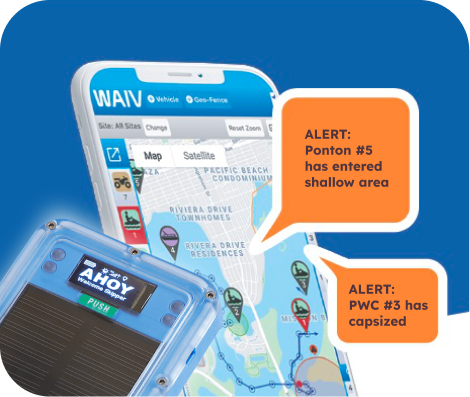
Direct capsize detection: WAIV’s patented flip-over detection is the only feature in this group specifically built to sense a PWC rolling and send an instant alert. It’s a hardware-level detection, not an estimate, and it’s the clearest example of where WAIV was engineered around jet ski risk specifically rather than adapted from a boat or car tracker.
Indirect indicators: Sensar Marine’s accelerometer logs G-force on impact, which can suggest a hard flip happened, but it’s not a dedicated capsize alert and the geofence side of its system only checks position after 15 minutes stationary, which is far too slow to catch a capsize as it happens.
No capsize signal at all: OtoTrak, BoatFix, Spytec, and Trackimo don’t publish a capsize detection feature. OtoTrak’s automatic throttle limiting is genuinely useful and reduces the odds of certain collision related flips, but it isn’t designed to detect a capsize that’s already occurred, which leaves a gap WAIV closes directly.
If your fleet has had even one incident where a flipped ski went unnoticed for a while, this single category probably matters more than every other line in the spec table combined, and it’s the clearest reason WAIV tends to be the right call for a rental operation.
Mounting and Physical Durability
A jet ski has dramatically less usable mounting space than a boat, and a much higher chance of full submersion during normal use, not just an accident.
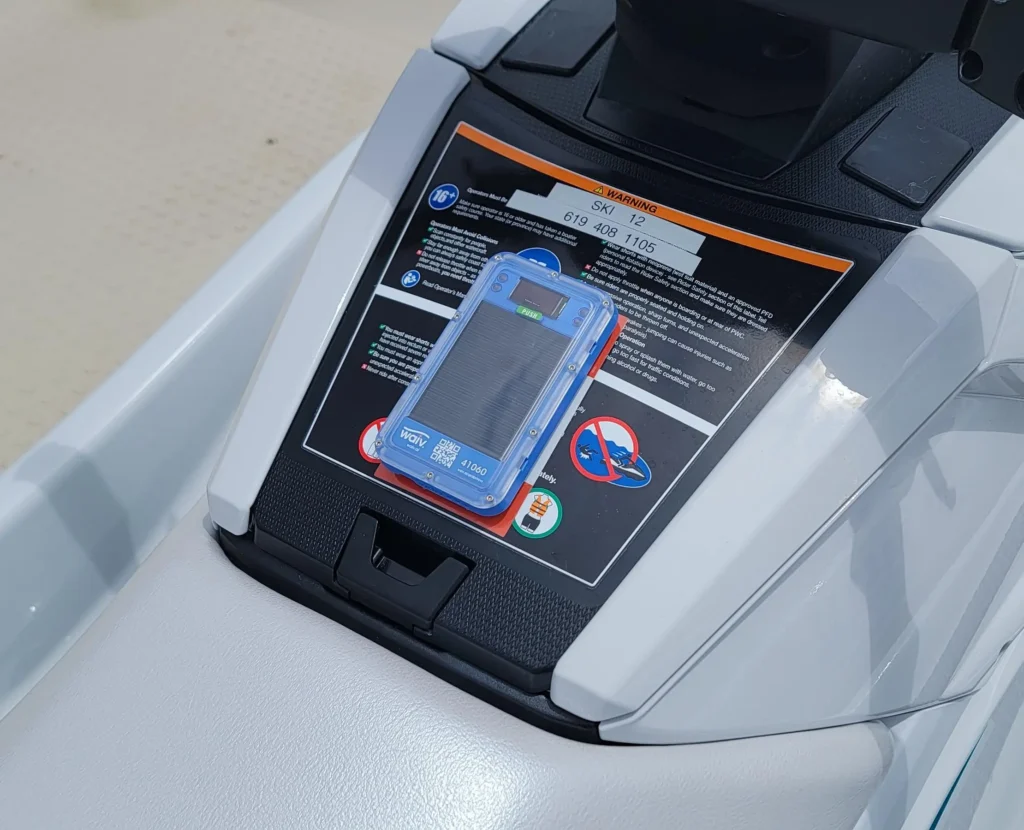
WAIV’s AHOY is compact and solar powered, designed to sit somewhere that gets sun exposure without interfering with the ski’s operation, and it carries an IP68 rating, meaning it’s built for sustained exposure, not just splashes. Among the trackers here, it’s the only one combining a wire-free install with a fully published IP68 rating, which is a meaningful advantage on a vehicle that regularly ends up underwater.
Spytec’s trackers use a small magnetic mount, convenient for quick placement but generally requiring an add-on case to hold up to regular submersion, since the base unit is only water resistant rather than fully waterproof.
Trackimo similarly isn’t waterproof out of the box and relies on an accessory power kit for marine use, which adds a step most operators would rather avoid.
BoatFix and Sensar Marine are both hardwired, which works well on a boat with room for a proper install but is a tighter fit on a PWC’s limited internal space. Both are solid, well-built systems; they’re simply designed with boats as the primary use case.
OtoTrak’s hardware needs to interface directly with the ski’s electronic throttle system, so its mounting and integration path is really an extension of the ski’s own electronics rather than an independent add-on device.
Update Frequency and Real-Time Response
Update frequency decides how useful a tracker actually is in the moment something goes wrong, and it varies more across this group than the marketing usually suggests.
WAIV and OtoTrak both operate in real time for their core safety functions: WAIV’s siren fires within seconds of a violation, and OtoTrak’s throttle limiting engages immediately on proximity or boundary detection. Neither is waiting on a periodic check-in, which is why they’re the two strongest options for fast-moving PWC incidents. The distinction is that WAIV’s real-time response covers a broader set of events, including capsizing and speed violations, while OtoTrak’s is focused specifically on proximity and boundary enforcement.
Sensar Marine’s geofence alert requires the ski to sit stationary for about 15 minutes before it fires, which makes sense for detecting an unauthorized boat left somewhere overnight but is far too slow to catch a fast moving PWC incident as it happens.
Spytec and Trackimo are both notification based on an interval, useful for general location awareness but not built around instant, safety critical response.
App and Fleet Platform Comparison
WAIV’s platform is built around managing a mixed fleet of boats and jet skis from one dashboard, with multi-site support and role-based permissions so dock staff and managers see different views. For an operator running more than one location, or renting both boats and skis, this is the most complete fleet layer in the comparison.
OtoTrak’s app is centered specifically on PWC monitoring and control, giving operators visibility and, given its throttle integration, a level of direct intervention the others don’t offer. It’s a focused, well-executed platform for jet-ski-only fleets on compatible models.
BoatFix and Sensar Marine both provide fleet-wide dashboards, with BoatFix backed by a live 24/7 monitoring team and Sensar Marine leaning more on digital trip logs and impact data for after the fact review. Both are credible fleet platforms with genuine strengths, particularly BoatFix’s human monitoring.
Spytec and Trackimo are built as general asset tracking platforms first. They’ll show you where a device is, but neither offers the rental-specific fleet tools, staff permissions, or PWC safety features the purpose built options do.
Pricing Side by Side
| Tracker | Device Cost | Monthly Cost | Contract |
|---|---|---|---|
| WAIV AHOY | Included with plan | $12.95/month (promo) | None, month to month, 30 day money back guarantee |
| OtoTrak | Not published | Not published | Not published |
| BoatFix | Not published | Not published | Subscription, contact for quote |
| Sensar Marine | ~$399 | Subscription add-on | Not published |
| Spytec GPS | Often bundled with plan | From $22.95/month | No long term contract on most plans |
| Trackimo | ~$139.95 | Annual service fee (~$60/year) | Device purchase plus annual service |
Comparing price alone across this list is misleading, since you’re paying for very different capability sets. WAIV is notable here for pairing the lowest published starting rate with the most PWC-specific safety features and the most transparent, flexible terms, no device cost, no contract, and a 30 day money back guarantee. A tracker with no capsize detection and interval-only alerts costing more per month than one with real time, on-device alerting and patented capsize detection isn’t the better deal just because the sticker price appears elsewhere.
Which Tracker Fits Which Rider or Fleet
Rental fleets with mixed boats and jet skis: WAIV, for the combined dashboard, patented capsize detection, and the fact that its safety features aren’t limited to specific ski models. This is the best overall fit for most rental operations.
Fleets made up entirely of compatible Sea-Doo or Yamaha models, mainly worried about ski-to-ski proximity: OtoTrak, for its automatic throttle limiting, is worth a close look, though WAIV remains the stronger all-round choice once capsize risk enters the picture.
Operations wanting live human monitoring alongside GPS: BoatFix, for its 24/7 team and maintenance sensors.
Owners wanting impact documentation for insurance or liability purposes: Sensar Marine, for its G-force logging and trip history.
Individual owners on a tight budget who mainly want basic location tracking: Spytec, provided you add appropriate waterproof protection.
Owners who also want to track other vehicles from the same account: Trackimo, given its cross-category asset tracking focus.
FAQs Comparing Jet Ski GPS Trackers
What is the best GPS for a jet ski?
For rental fleets, WAIV is the best GPS for jet ski use overall, because it’s the only tracker in this comparison combining patented capsize detection with an on-device siren that fires in seconds even without a live cell connection. Those two features address the risks most specific to PWCs, which is why WAIV ranks first in this jet ski GPS comparison.
What’s the most important spec to compare when choosing a jet ski GPS tracker?
Alert speed and capsize detection matter more than most other specs for PWCs specifically. A jet ski can go from fine to in trouble in seconds, so a tracker that only checks in every fifteen minutes, or that has no way to detect a flip, leaves a real gap regardless of what else it offers.
Do any of these trackers work without cell service?
All six rely on cellular connectivity to transmit alerts remotely. WAIV’s geofence logic runs on the device itself, so its siren still fires locally even without a live connection at that exact moment, which sets it apart from the others; reaching staff remotely still requires cell service for any tracker here.
Is a higher priced tracker always the better choice?
No. Price differences here mostly reflect different feature sets, not just quality differences. Compare what each device actually detects and how fast it responds before assuming a higher monthly cost means a better product for your specific use case.
Can I compare these trackers on a single jet ski before committing to a fleet?
Most of these providers, including WAIV, sell or subscribe on a per-device basis, so testing on one or two skis before a full fleet rollout is generally possible. WAIV specifically backs this with a 30 day money back guarantee, which makes a low-risk trial straightforward. Confirm return or cancellation policies directly with each provider before buying in bulk.
Which trackers are actually built for jet skis specifically, versus adapted from boat or general asset trackers?
WAIV and OtoTrak were both built with PWC specific risks in mind from the start. BoatFix and Sensar Marine were originally built for boats and extended to jet skis. Spytec and Trackimo are general purpose asset trackers not built for marine use specifically at all.
