


Key Takeaways (TL;DR)
- This waiv vs ototrack comparison looks at two well-built systems that approach jet ski rental safety differently.
- WAIV comes out ahead as the best jet ski gps for most rental fleets, mainly because it’s the only one of the two with dedicated, patented capsize detection and because its safety features work on any ski regardless of make or model year.
- OtoTrak’s automatic throttle limiting is a genuinely clever approach to collision prevention, and it’s a strong option for fleets built entirely on compatible skis where proximity is the main concern.
- OtoTrak only works on post-2009 Sea-Doo and Yamaha WaveRunner models with electronic throttle control. WAIV isn’t tied to a specific ski brand or model year.
- WAIV runs on solar power with a wire free install and publishes a starting price; OtoTrak’s throttle limiting hardware ties into the ski’s electronic systems and requires a direct quote.
Table of Contents
- WAIV vs Ototrack at a Glance
- Scorecard: How the Two Compare
- What Each Company Actually Does Differently
- Capsize and Safety Detection
- Geofencing and Speed Enforcement
- Fleet Management and Multi-Location Tools
- Installation and Hardware
- Pricing and Contract Terms
- Who Should Choose WAIV
- Who Should Choose OtoTrak
- Final Verdict
- FAQs About WAIV vs Ototrack
WAIV vs Ototrack at a Glance
| Category | WAIV AHOY | OtoTrak |
|---|---|---|
| Core Approach | Instant on-device siren and strobe alert the renter directly | Automatically limits throttle to idle speed on violation |
| Capsize Detection | Yes, patented flip-over detection with instant text alert | Not published as a feature |
| Works Without Cell Coverage | Yes, geofence logic runs on the device | Not specified; app based monitoring and control |
| Ski Compatibility | Not brand or model dependent | Requires post-2009 Sea-Doo or Yamaha WaveRunner with electronic throttle control |
| Install Type | Solar powered, wire free | Integrates with the ski's electronic throttle system |
| Fleet Dashboard | Multi-site management with role-based staff permissions | Real time monitoring and control via mobile app |
| Multi-Vessel Type Support | Boats and jet skis under one dashboard | Jet skis and PWCs specifically |
| Contract Terms | No long term contract, 30 day money back guarantee | Not published |
| Starting Price | $12.95/month (promotional) | Contact for quote |
| Primary Market | United States and international rental fleets | Primarily European and select international rental markets |
Scorecard: How the Two Compare

For a quick read before the detailed sections, here’s how WAIV and OtoTrak score across the factors that matter most to a jet ski rental operation. Each is rated out of 5, and the notes explain the gap where there is one.
| Factor | WAIV AHOY | OtoTrak | Why |
|---|---|---|---|
| Capsize response | 5 | 2 | WAIV has patented capsize detection; OtoTrak publishes none |
| Collision prevention | 4 | 5 | OtoTrak's automatic throttle limiting is the more forceful mechanism for proximity specifically |
| Alert speed | 5 | 5 | Both respond in real time to their core triggers |
| Ski compatibility | 5 | 3 | WAIV works on any ski; OtoTrak needs compatible throttle-by-wire models |
| Ease of install | 5 | 3 | WAIV is wire-free solar; OtoTrak requires throttle-system integration |
| Fleet and multi-site tools | 5 | 4 | WAIV manages boats and skis together with role-based permissions |
| Pricing transparency | 5 | 3 | WAIV publishes a starting rate; OtoTrak is quote-only |
| Overall | 34 / 35 | 26 / 35 | WAIV leads on breadth; OtoTrak is strongest on proximity enforcement specifically |
The scorecard captures the core story of this ototrack vs waiv comparison: OtoTrak edges ahead on the single dimension of automatic collision prevention, which is a real strength, while WAIV leads across every other factor, most importantly capsize response, where the gap is widest.
What Each Company Actually Does Differently
Both WAIV and OtoTrak were built to solve the same underlying problem: renters on jet skis who don’t know local waters, don’t know how fast they’re going, and can end up in a collision or a grounding within seconds of a lapse in attention. Where they differ is in what happens once a boundary gets crossed.
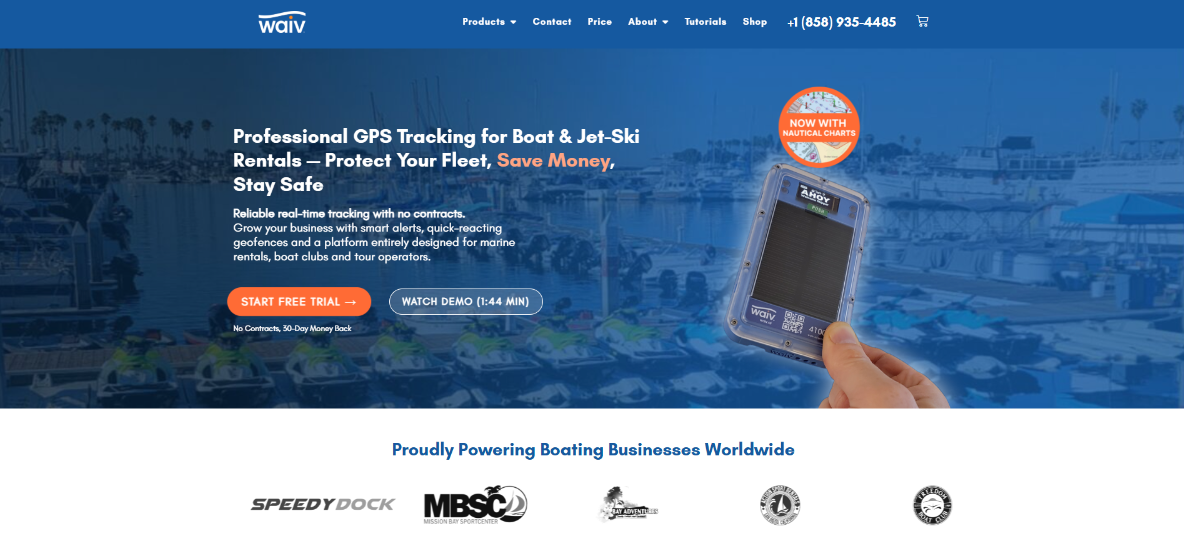
WAIV’s approach is to alert immediately and let the renter self-correct.
![]()
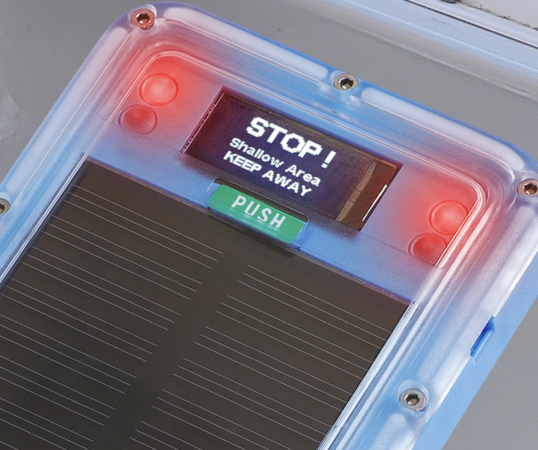
The SoundAlertSystem triggers a loud siren and strobe on the ski itself the moment a geofence is crossed or a speed limit exceeded, and because the geofence logic runs on the device rather than a remote server, it fires even with zero cell signal at that exact moment. The renter hears it, turns around, problem avoided. Crucially, this same system also covers events OtoTrak’s doesn’t, most notably capsizing.
OtoTrak takes the decision out of the renter’s hands entirely for the violations it covers.
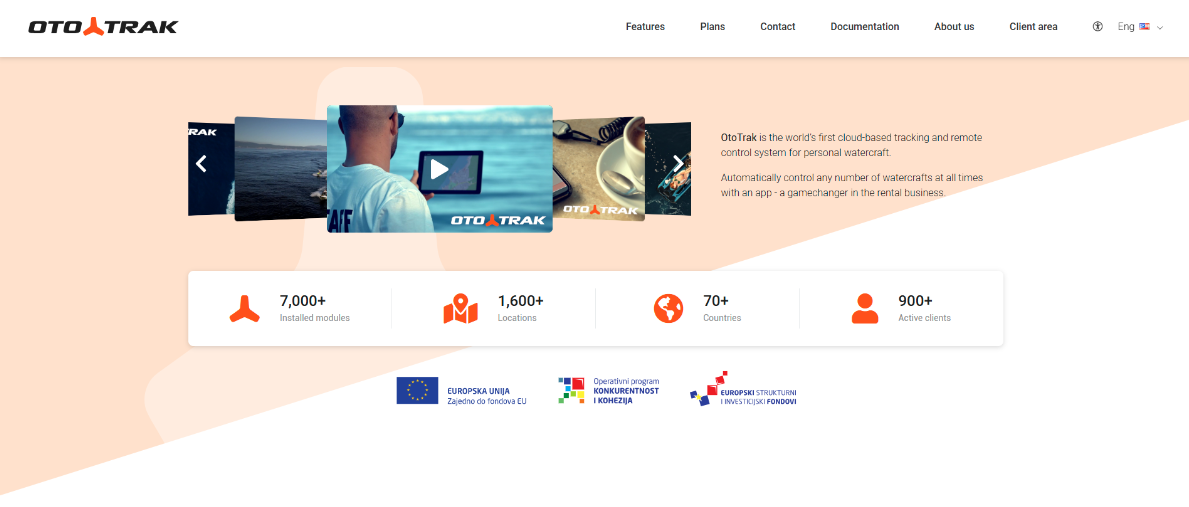
Rather than warning them, its system communicates with the ski’s electronic throttle control and physically reduces speed to idle, either when two OtoTrak equipped skis come within roughly fifty meters of each other or when a ski crosses a defined geofence. There’s no reaction time required from the renter because the ski simply won’t go fast enough to cause the collision or run the boundary. It’s a genuinely effective mechanism for proximity specifically.
Neither approach is objectively better in every situation. An automatic throttle limiter removes dependence on renter reaction time for collisions, which is a real advantage. An instant, offline-capable alert system covers a wider range of risks, works on any ski, and doesn’t depend on a throttle integration, which is why WAIV ends up the more complete solution for most fleets.
Capsize and Safety Detection
This is one of the clearest differences between the two systems, and the area where WAIV’s advantage is largest.
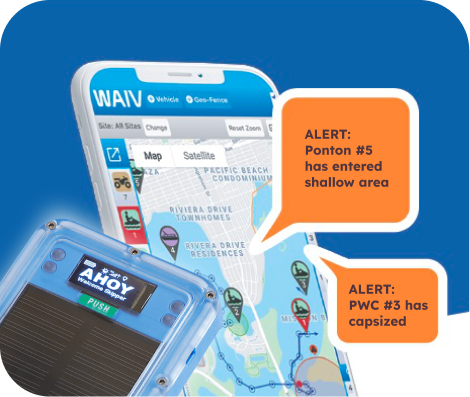
WAIV’s AHOY includes a patented flip-over detection feature. If a jet ski capsizes, whether from a hard turn, a wake, or renter error, the device detects the roll and sends an instant text alert to staff. This matters specifically for PWCs because a flipped ski can begin taking on water immediately, and an engine that keeps running while submerged can suffer serious, expensive damage within minutes if nobody notices right away.
OtoTrak does not publish a dedicated capsize detection feature. Its system is built around proximity and boundary enforcement through throttle control, which it does well, but it isn’t designed to detect what happens after a ski has already flipped. For an operator whose concerns include capsize response, this is a meaningful gap that WAIV fills directly.
Where this leaves you: if capsize response matters to your fleet at all, WAIV covers it directly and OtoTrak doesn’t. If your fleet has had even one incident where a flipped ski went unnoticed for a while, this single category probably matters more than every other line in the spec table combined, and it’s the clearest reason WAIV tends to be the right call for a rental operation.
Geofencing and Speed Enforcement
Both systems use geofencing, but they enforce it differently, and the mechanism matters as much as the boundary itself.
WAIV’s geofence logic runs directly on the device. When a ski crosses a boundary or exceeds a set speed, the on-device siren and strobe fire in seconds, independent of cell coverage. This is an alert-based system: the renter is warned and expected to respond. Because it doesn’t rely on a throttle integration, it works on any ski in your fleet.
OtoTrak’s geofencing is enforcement based rather than alert based. Crossing a boundary, or getting within about fifty meters of another OtoTrak equipped ski, triggers an automatic reduction to idle speed. There’s no reliance on the renter noticing an alert or choosing to slow down, which is a genuine strength for proximity enforcement. The tradeoff is that this level of integration requires direct communication with the ski’s throttle control system, which is why it’s limited to specific compatible models.
Where this leaves you: OtoTrak’s enforcement is more forceful for the specific violations it covers, while WAIV’s alerting is more flexible, works on any ski make or model, and covers speed and capsize events in the same system.
Fleet Management and Multi-Location Tools
WAIV’s fleet tools are built to manage jet skis and boats together under one dashboard.
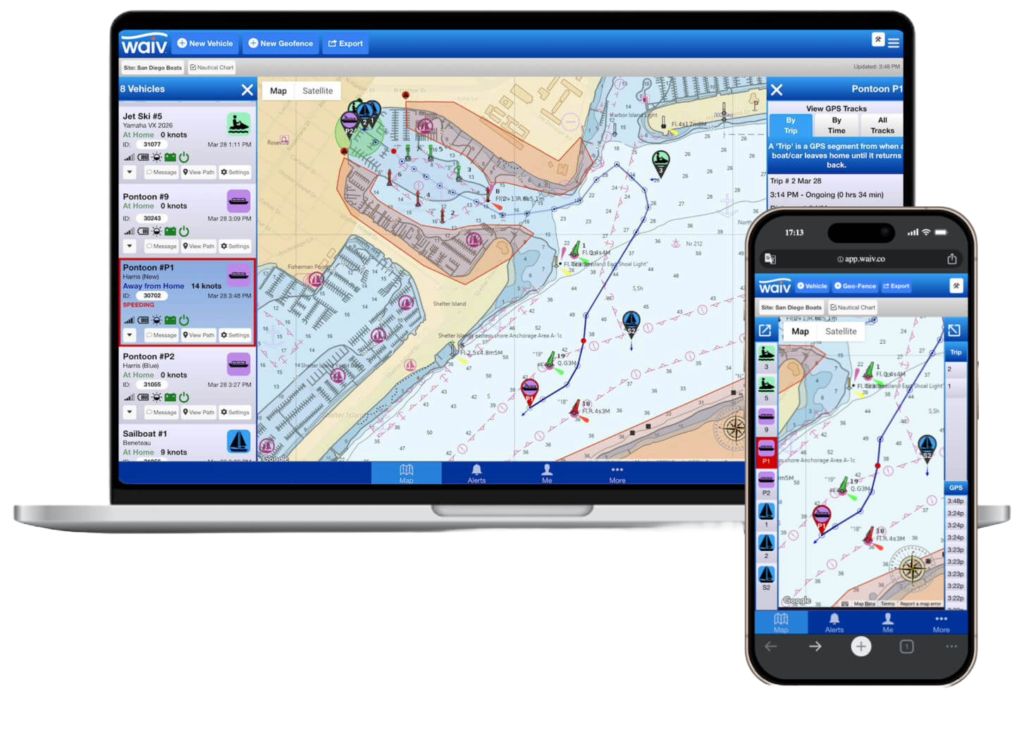
Multi-site management lets operators running more than one location toggle between sites or view the entire fleet at once, and role-based staff permissions mean dock hands, managers, and seasonal employees each see only what’s relevant to them.
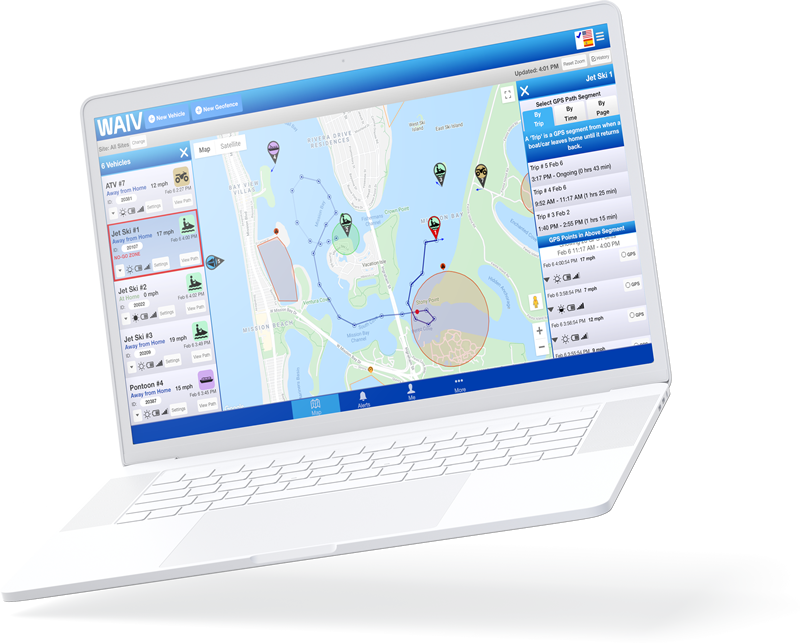
For a growing or mixed-vessel rental business, this is a meaningful operational advantage.
OtoTrak’s platform provides real time monitoring and control specifically for jet skis and PWCs through a mobile app, allowing operators to see fleet status and, given its throttle control integration, intervene directly if needed.
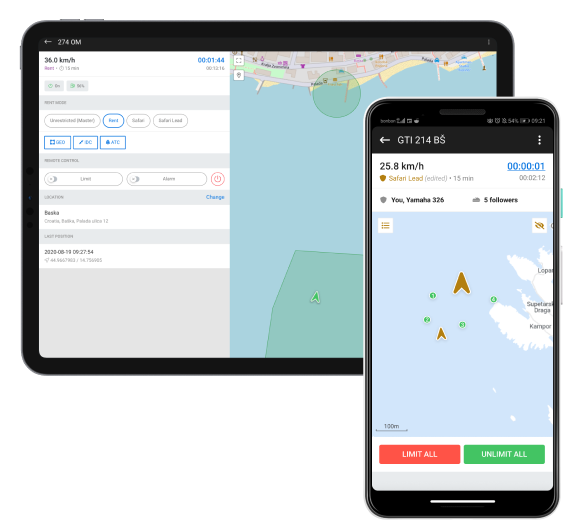
It’s a focused, capable platform, though its published fleet tools center on the PWC side rather than mixed boat and jet ski operations.
Where this leaves you: if your rental business runs both boats and jet skis, or operates across multiple sites, WAIV’s mixed-fleet dashboard is the more complete fit. If your fleet is exclusively jet skis on compatible models, OtoTrak’s PWC-focused tools cover that specific case well.
Installation and Hardware
WAIV’s AHOY is solar powered and installs without wiring into the ski’s electrical system, which matters given how little mounting space a PWC actually has.
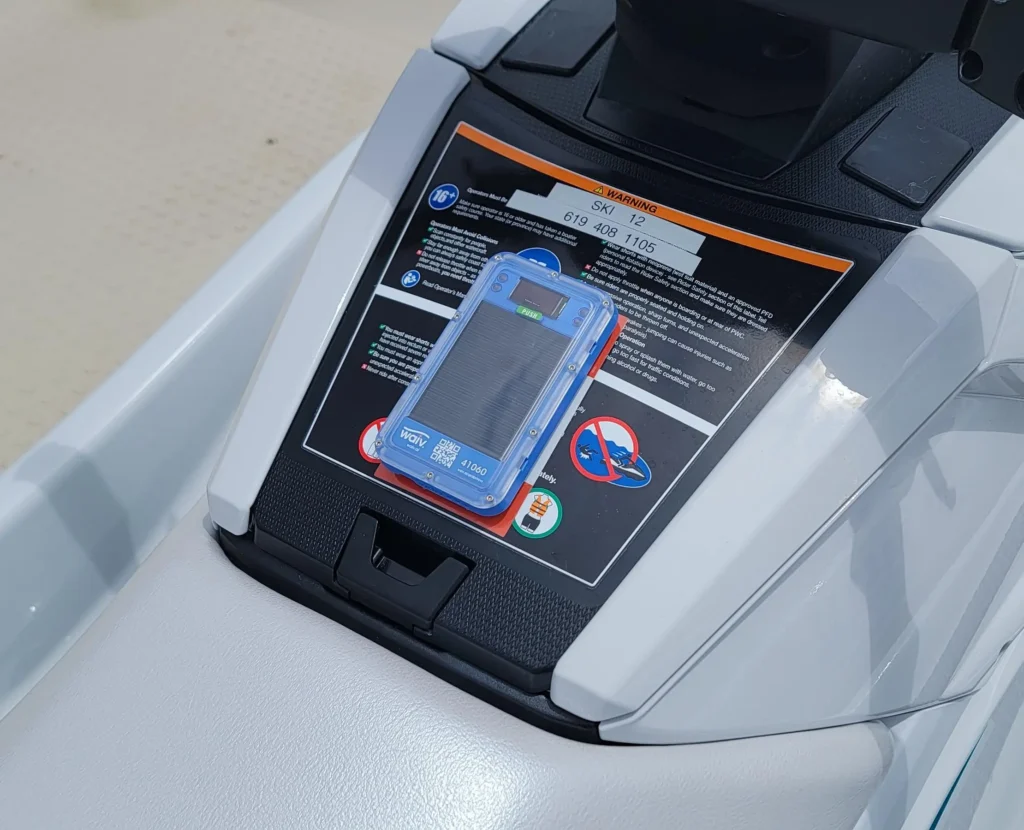
There’s no battery to charge or swap under normal conditions, and the IP68 waterproof rating is built for a device that may end up fully submerged during a flip. Across a fleet, this wire-free approach makes installation fast and keeps it independent of ski model.
OtoTrak’s system, because it needs to communicate with and limit the ski’s electronic throttle, integrates more directly with the vehicle’s existing systems rather than sitting as an independent add-on. This is a more involved technical integration by nature, since the whole feature depends on that connection working reliably, and it’s the reason the system is tied to specific models and years. That integration is also exactly what enables OtoTrak’s headline capability, so it’s a reasonable tradeoff for fleets that want automatic throttle control.
Where this leaves you: WAIV’s install is simpler, faster across a fleet, and works on any ski. OtoTrak’s install is inherently tied to the ski’s throttle electronics, which is both the source of its unique capability and the reason its compatibility is limited.
Pricing and Contract Terms
WAIV publishes a promotional starting rate of $12.95 per month per device, with no long term contract and pricing that can flex month to month for seasonal operators. Every order includes a 30 day money back guarantee, and first time customers can return up to five devices even after active use. That transparency and flexibility make it easy to trial before committing.
OtoTrak does not publish pricing publicly. Fleet cost depends on ski count and location, and operators need to contact the company directly for a quote.
Where this leaves you: WAIV gives you a published starting point and a low-risk way to test the system. With OtoTrak, you’ll need a direct quote before you can compare total cost either way.
Who Should Choose WAIV
WAIV tends to be the stronger choice if:
- Your fleet includes any mix of jet skis and boats, and you want one dashboard for both
- Capsize response is a concern at all, which it is for most PWC operations
- You want a system that isn’t dependent on a specific ski make, model, or year
- You want the fastest, simplest install across a fleet, with no wiring or throttle integration
- You’d rather warn the renter and let them self-correct while still covering speed and capsize events
- You want published pricing and flexible, contract free terms with a money-back guarantee
For most rental operators, this describes their situation, which is why WAIV is the better default.
Who Should Choose OtoTrak
OtoTrak is worth consideration if:
- Your fleet is made up entirely of compatible post-2009 Sea-Doo or Yamaha WaveRunner models
- Ski-to-ski proximity collisions have been your single biggest operational problem
- You specifically want automatic, non-negotiable speed enforcement rather than an alert the renter has to act on
- Capsize response is already handled another way in your operation
Final Verdict
Both systems are well built and solve real problems, and OtoTrak’s automatic throttle limiting is a genuinely smart approach to collision prevention that some fleets will value highly. For most jet ski rental operators, though, WAIV is the stronger overall choice. It’s the only one of the two with patented capsize detection, its safety features work on any ski rather than a specific list of compatible models, its install is faster and simpler across a fleet, and its pricing is transparent and flexible.
OtoTrak’s advantage is concentrated in one dimension, proximity enforcement, while WAIV leads across capsize response, compatibility, install, fleet tools, and pricing. Unless your fleet is entirely compatible skis and collisions are your only concern, WAIV covers more of what a rental operation actually needs.
FAQs Comparing Jet Ski GPS Trackers
Which is the best jet ski GPS, WAIV or OtoTrak?
For most rental fleets, WAIV is the best jet ski gps of the two, because it combines patented capsize detection with instant, offline-capable alerting that works on any ski model. OtoTrak is an excellent choice specifically for fleets of compatible skis whose main concern is proximity collisions, thanks to its automatic throttle limiting.
Is OtoTrak compatible with any jet ski?
No. OtoTrak’s throttle limiting feature requires post-2009 Sea-Doo or Yamaha WaveRunner models with electronic, fly-by-wire throttle control. WAIV, by contrast, isn’t tied to any particular ski make or model year, which is one reason it’s a more flexible option for mixed fleets.
Does WAIV physically slow down a jet ski like OtoTrak does?
No. WAIV’s SoundAlertSystem triggers an on-device siren and strobe to warn the renter, who is then expected to slow down or turn around. OtoTrak physically reduces the ski’s speed. Both are effective; WAIV’s approach works on any ski and also covers capsize and speed events, while OtoTrak’s is more forceful for proximity specifically.
Which one is better for capsize incidents?
WAIV, clearly, since it includes a patented capsize and flip-over detection feature with an instant alert. OtoTrak does not publish a dedicated capsize detection capability, so most fleets concerned with capsizing will find WAIV the better fit.
What are the main OtoTrak alternatives for a jet ski rental fleet?
WAIV is the leading OtoTrak alternative, offering patented capsize detection and instant on-device alerting on any ski model. Other options operators sometimes consider include BoatFix and Sensar Marine, though those were originally built for boats and lack OtoTrak’s automatic enforcement and WAIV’s dedicated capsize detection.
Can I run WAIV and OtoTrak on the same fleet?
There’s no published information suggesting the two systems are designed to integrate with each other, and each addresses a different part of the safety picture. Most operators will choose one as their primary system; for the majority, WAIV’s broader coverage makes it the more practical single choice.
Which company has more transparent pricing?
WAIV publishes a promotional starting rate of $12.95 per month per device with no long term contract and a 30 day money back guarantee. OtoTrak requires a direct quote based on ski count and location.
